Side sleeping is the most popular sleep position, and for good reason — many people simply find it the most comfortable way to drift off. But it also creates a gap between your head and the mattress that your pillow has to fill. Get that gap wrong and you can wake up with a stiff neck or sore shoulder. Get it right and your head, neck and spine rest in one easy, straight line.
Why alignment matters
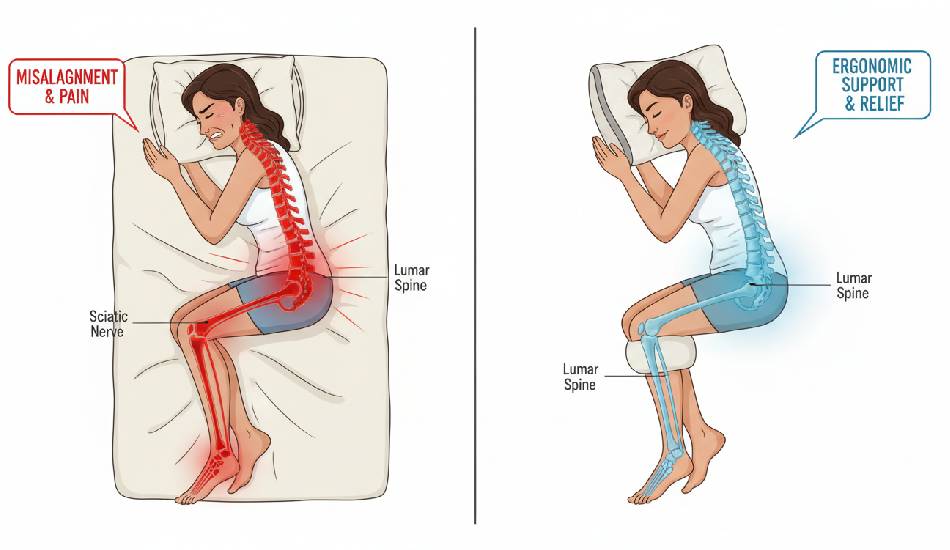
Look at the illustration above. On the left, the pillow is the wrong height, so the neck bends and the spine curves out of line. On the right, the pillow supports the head at the same level as the spine, so everything stays neutral. That neutral line is the goal. When your neck spends hours tilted up or down, the muscles around it work overtime — and that strain is often what you feel in the morning.
Step 1: Find your loft
Loft is simply how tall your pillow is when you lie on it. Side sleepers usually need more loft than back or stomach sleepers, because the pillow has to make up the full distance between the mattress and your head. Many side sleepers find somewhere around 4 to 6 inches comfortable, but the right number depends on your body:
- Broader shoulders usually need a taller pillow.
- A softer mattress lets your shoulder sink in, so you may need a little less loft.
- A firmer mattress keeps your shoulder higher, so you may need a little more.
A quick way to estimate: measure from the side of your neck to the outer edge of your shoulder. That distance is a good starting point for the compressed height you want.
Step 2: Choose a firmness and fill
Firmness decides whether your pillow holds that loft all night or slowly flattens. Side sleepers generally do best with medium-firm to firm support. Here's how the most common fills compare:
- Memory foam contours to your head and neck and keeps its shape — a popular pick for steady support.
- Shredded memory foam lets you add or remove fill to fine-tune the height.
- Latex is springy and supportive, and tends to sleep a little cooler than solid foam.
- Down and feather feel soft and luxurious but compress more, so you may need to fold or double them.
- Contoured (cervical) pillows have a raised edge that cradles the curve of your neck.
Step 3: Support the rest of your body
Your neck is only part of the picture. If your top knee drops forward during the night, it can twist your hips and lower back. Placing a slim pillow between your knees keeps your hips stacked and level. Some side sleepers also like hugging a pillow, which stops the top shoulder from rolling forward.
Lie on your side on your pillow and ask someone to look at you from behind. Your nose should line up with the center of your chest, and your neck should look level — not tilted up toward the ceiling or down toward the mattress.
When to replace your pillow
Even the best pillow wears out. If yours has lumps, stays flat after you fluff it, or no longer springs back into shape, it isn't giving you the support it used to. Many pillows benefit from replacing every one to two years, and good bedding — like breathable cotton sheets — helps keep you comfortable while you sleep.
One last note: a better pillow can make a real difference to everyday comfort, but it isn't a treatment. If neck or shoulder pain is ongoing, it's worth checking in with a doctor or physical therapist.